







Car Alternator in Dubai
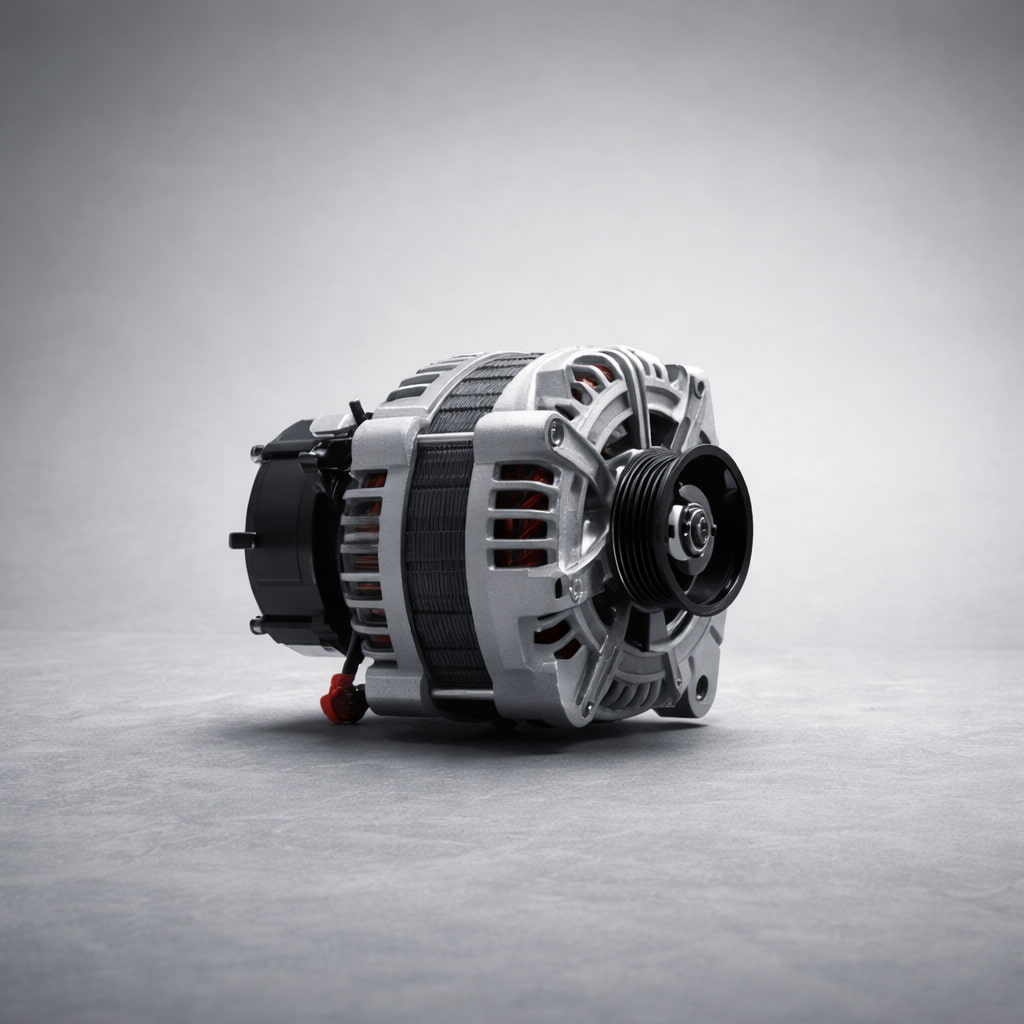
The alternator is the engine’s onboard electrical generator — the component responsible for charging the battery while the engine runs and for supplying the electrical power consumed by every system in the vehicle during operation. Every modern vehicle is electrically dependent to a degree that was unimaginable in earlier generations of automotive engineering. The engine management system, the fuel injection system, the ignition system, the anti-lock braking system, the electronic power steering, the air conditioning, the infotainment system, every lighting circuit, and every active safety system draws current continuously while the engine runs. All of this electrical demand is met by the alternator, which converts a small fraction of the mechanical energy available at the engine’s crankshaft into electrical energy through electromagnetic induction, rectifies it from alternating to direct current, and delivers it to the vehicle’s electrical bus at a regulated voltage that maintains both the battery state of charge and the system voltage within the narrow tolerances that modern electronic control units require.
When the alternator fails, the consequences are immediate and follow a predictable escalation. The battery charge warning light illuminates first — indicating that the battery voltage has fallen below the normal charging threshold. As the battery begins to discharge under the vehicle’s continuing electrical demand without replenishment from the alternator, system voltage progressively declines. The engine management system begins receiving sensor inputs corrupted by incorrect supply voltage and makes progressively worse fuelling and ignition decisions. Active safety systems that require minimum supply voltage to remain operational begin to deactivate. Ultimately the engine stalls as ignition system voltage falls below the minimum threshold for coil operation. A vehicle driven to complete electrical failure through alternator neglect risks damage to sensitive control units from the voltage instability that precedes total discharge — damage that compounds the cost of the original alternator failure significantly. At Fortune Plus Auto in Dubai, we stock alternators for a comprehensive range of vehicle applications to ensure that alternator failure can be resolved quickly and correctly.
How an Alternator Generates Electricity
The alternator operates on the principle of electromagnetic induction. Its core components are the rotor — a rotating electromagnet powered by a small DC excitation current through slip rings and carbon brushes — and the stator, which is a fixed assembly of three-phase copper windings arranged around the rotor. As the rotor spins inside the stator, driven by the engine via a pulley and drive belt, its rotating magnetic field induces alternating current in each phase of the stator windings. This three-phase AC output is then rectified to DC by a set of six power diodes arranged in a bridge configuration, and the resulting DC output is regulated to the vehicle’s required charging voltage by the voltage regulator — typically integrated into the brush holder assembly — which adjusts the rotor excitation current to maintain consistent output voltage across the full range of engine speeds and electrical loads.
The alternator is therefore not a simple passive component. It is a continuously adapting electrical machine whose internal control system responds in real time to changes in engine speed, battery state of charge, and total electrical load. Modern alternators on vehicles with sophisticated energy management systems communicate bidirectionally with the engine control unit, allowing the ECU to reduce alternator load during acceleration phases (when the full crankshaft power is needed for vehicle performance) and increase it during overrun and braking (when engine braking energy would otherwise be wasted). Understanding this sophistication helps explain why fitting an incorrectly specified or low-quality alternator on a modern vehicle creates problems beyond simply insufficient charging.
Diagnosing Alternator Failure: A Systematic Approach
Before replacing an alternator, systematic diagnosis is essential to confirm that the alternator is the actual fault rather than a symptom of a related failure in the battery, the drive belt system, or the vehicle’s wiring. The consequences of fitting a new alternator to a vehicle with an underlying fault that caused the original failure — a defective battery, a loose wiring terminal, or a failing pulley — are a premature repeat failure of the replacement unit and an unsatisfied customer.
- Battery open circuit voltage test: a fully charged, healthy battery at rest should measure 12.6 volts or above. A reading below 12.0 volts indicates a discharged or genuinely defective battery. Replace or charge and retest the battery before drawing conclusions about the alternator.
- Charging voltage at idle: with the engine running at idle and minimal electrical load, the battery terminal voltage should rise to 13.8 to 14.4 volts. A reading that remains at battery rest voltage confirms the alternator is producing no output.
- Charging voltage under load: apply full electrical load — headlights full beam, air conditioning, rear window defrost, blower on maximum. The alternator output voltage should remain above 13.5 volts. A voltage that drops below 13 volts under full load indicates the alternator cannot meet the vehicle’s peak demand — either through internal wear or insufficient rated output for the vehicle’s electrical configuration.
- AC ripple measurement: using a multimeter’s AC voltage measurement mode on the DC supply terminals, AC content above 50 millivolts indicates diode failure in the rectifier pack. AC ripple on the DC supply causes battery drain (the battery cannot charge efficiently against an AC-contaminated supply), damages sensitive electronic control units, and interferes with radio and audio systems.
- Drive belt and pulley condition: confirm the drive belt is intact, correctly tensioned, and that the alternator pulley turns freely in the charging direction and locks in the drive direction. A seized or slipping pulley prevents the alternator from turning at the speed required for adequate output.
Overrunning Alternator Pulley: The Hidden Failure Mode
Many modern alternators — particularly those fitted to European vehicles and higher-specification Japanese applications — are equipped with an overrunning alternator pulley (OAP) rather than a conventional fixed pulley. The OAP incorporates a one-way sprag clutch mechanism between the pulley shell and the alternator shaft. During engine acceleration, the pulley drives the alternator shaft normally through the clutch engagement. During engine deceleration — when engine speed drops rapidly — the clutch disengages, allowing the alternator rotor to continue spinning briefly under its own inertia while the drive belt decelerates at the engine’s rate. This decoupling prevents the significant belt tension spike that a fixed-pulley alternator with a heavy, high-inertia rotor would generate on deceleration — spikes that otherwise cause accelerated belt and tensioner wear and contribute to the characteristic belt noise associated with high-load alternators.
When the OAP’s sprag clutch fails — which it does through wear of the clutch ramp surfaces, typically above 80,000 to 100,000 km — it can fail in either the slip or lock condition. A slipping OAP causes intermittent or complete loss of alternator output as the clutch fails to transmit rotational drive from the belt to the shaft under load. A locked OAP causes the same belt tension spikes and noise that the OAP was designed to prevent — often accompanied by accelerated accessory belt and tensioner wear. OAP diagnosis requires a specific sprag clutch test tool or careful observation of the pulley’s one-way rotation behaviour. Our team can advise on identifying OAP failure and whether the OAP should be replaced as a separate component or as part of a complete alternator replacement.
Alternator Wiring: The Often-Skipped Diagnostic Step
Alternator failures that are actually wiring failures are remarkably common in Dubai’s operating environment. The underbonnet temperature extremes experienced in UAE conditions accelerate the brittling of connector housings, the degradation of wire insulation, and the galvanic corrosion of electrical contacts — particularly at the main output terminal and the multi-pin regulation connector. Before condemning an alternator that shows no output, spend ten minutes inspecting the wiring harness connections at the alternator. The B+ output terminal connection should be clean, tight, and showing no signs of overheating or corrosion. The multi-pin regulation connector should engage fully with no bent or recessed pins and no oxidation on the contact faces. A loose B+ terminal or a corroded regulation connector can prevent alternator output completely — and cleaning or repairing the connection costs a small fraction of a replacement alternator.
New OEM vs. Remanufactured Alternators: Making the Right Choice
Alternator replacement involves a meaningful choice between new OEM-specification units and professionally remanufactured units, and understanding the practical implications of each helps customers make the decision appropriate to their specific situation.
New OEM-specification alternators are manufactured to the vehicle manufacturer’s exact electrical specification with all-new components — new stator and rotor windings, new diode rectifier pack, new voltage regulator and brush assembly, new end-frame bearings. They carry the same output specifications as the factory-fitted unit and are appropriate for newer vehicles, vehicles operating in high-demand applications, situations where maximum component reliability is paramount, or fleet vehicles where unplanned downtime carries a high cost per hour.
Professionally remanufactured alternators rebuild original alternator housings and mechanical components with new or refurbished internal electrical components — replacing the diodes, regulator, brushes, and bearings while retaining the verified original housings and core assembly. Quality remanufacturing restores the alternator to its original output specification and provides a cost-effective alternative to new units — particularly for higher-mileage vehicles where the cost justification for a new unit is less compelling, or where a new OEM unit has an extended lead time. We supply only quality-verified remanufactured units from reputable suppliers with documented remanufacturing processes.
Alternator Output Rating: Why Amperage Specification Matters
Every alternator is rated for a maximum output current in amperes, and this rating must match the electrical demand profile of the vehicle it is fitted to. Alternators for base-specification vehicles — without premium audio, without heated seats, without additional lighting or auxiliary equipment — may be rated at 90 to 110 amperes. Higher-specification vehicles with air suspension, premium entertainment systems, or extensive auxiliary lighting may require 140 to 180 ampere units. Fitting an alternator rated below the vehicle’s peak electrical demand — whether through incorrect parts identification or deliberate cost reduction — causes the alternator to operate continuously at or above its rated current output. Sustained operation at maximum rated current overheats the stator windings, accelerates the degradation of the diode rectifier, and dramatically shortens alternator life. The fuel economy penalty of a permanently maximally loaded alternator is also measurable. Our team will confirm the correct output rating for your specific vehicle application and variant before supplying a replacement unit.
The Charging System as a Complete Assembly
The alternator is one component in a charging system that also includes the battery, the drive belt, and the voltage sensing and regulation wiring. These components function interdependently, and failure of any one affects the others. A battery with severely degraded cell capacity creates excessive demand on the alternator — forcing it to work at high output continuously to compensate for the battery’s inability to hold charge — and accelerating alternator wear. We recommend testing the battery whenever the alternator is replaced, and replacing it proactively if its capacity has fallen below 70% of rated value. Our complete range is available alongside our alternator inventory for complete charging system renewal from a single supplier.
The accessory drive belt that powers the alternator should also be inspected and replaced whenever the alternator is removed. A worn or cracking is an inexpensive proactive replacement that avoids a repeat alternator removal when the belt eventually fails — a job that costs far more in labour than the belt itself.
Fleet and Commercial Vehicle Alternator Supply
Fleet operators managing taxis, delivery vehicles, minibuses, and commercial trucks in Dubai rely on Fortune Plus Auto for alternator supply that supports the high-utilisation, high-electrical-demand operating profiles of commercial vehicle applications. Our wholesale service maintains stock across the most common commercial vehicle alternator applications and provides the turn-around speed required to minimise vehicle downtime. For fleet customers managing large vehicle populations, we can discuss stock reservation, scheduled supply, and account terms that align with fleet maintenance planning cycles.
Buy a Car Alternator at Fortune Plus Auto Dubai
We are open Monday to Saturday, 8:00 AM to 8:00 PM at 44 18b Street, Ras Al Khor Industrial Area 2, Dubai. To source the correct replacement alternator for your vehicle, bring the vehicle make, model, year, engine code, and if possible the output rating of the original unit — typically printed on the alternator’s data label. Our team will confirm the correct specification, advise on new versus remanufactured options for your application and budget, and check same-day stock availability. Call +971 50 206 9239 to confirm availability before travelling. Ample parking is available at our Ras Al Khor location.
Who We Serve
- Auto spare parts retailers seeking consistent stock
- Workshop and service centers requiring dependable components
- Fleet companies needing long-term parts supply
- Individual car owners and enthusiasts
How We Add Value

Sourcing and Selection
We source parts from reputable manufacturers and trusted supply chains that meet or exceed industry standards for reliability and safety.

Quality Verification
Each part undergoes quality checks to ensure it delivers performance, fit, and durability before being approved for sale.

Efficient Supply
With a strong logistics network and local operations in Dubai, we ensure timely delivery and availability for our customers.
Looking for Quality Auto Spare Parts?
We supply reliable automotive components trusted by workshops, retailers, and fleet operators. Contact us for product availability, expert assistance, and bulk supply options.